In a world flooded with counterfeit goods, from high-end electronics and luxury handbags to collectible currency and software keys, one string of characters stands as the guardian of authenticity: the serial number.
But what happens when the scammers get smart? What happens when the serial number itself is a lie?
Learning how to identify fake serial numbers is no longer just a skill for experts; it is a necessity for anyone buying pre-owned goods, collecting rare items, or purchasing gray-market software. A fake serial number can cost you hundreds of dollars, leave you with a voided warranty, or even land you in legal trouble with pirated software.
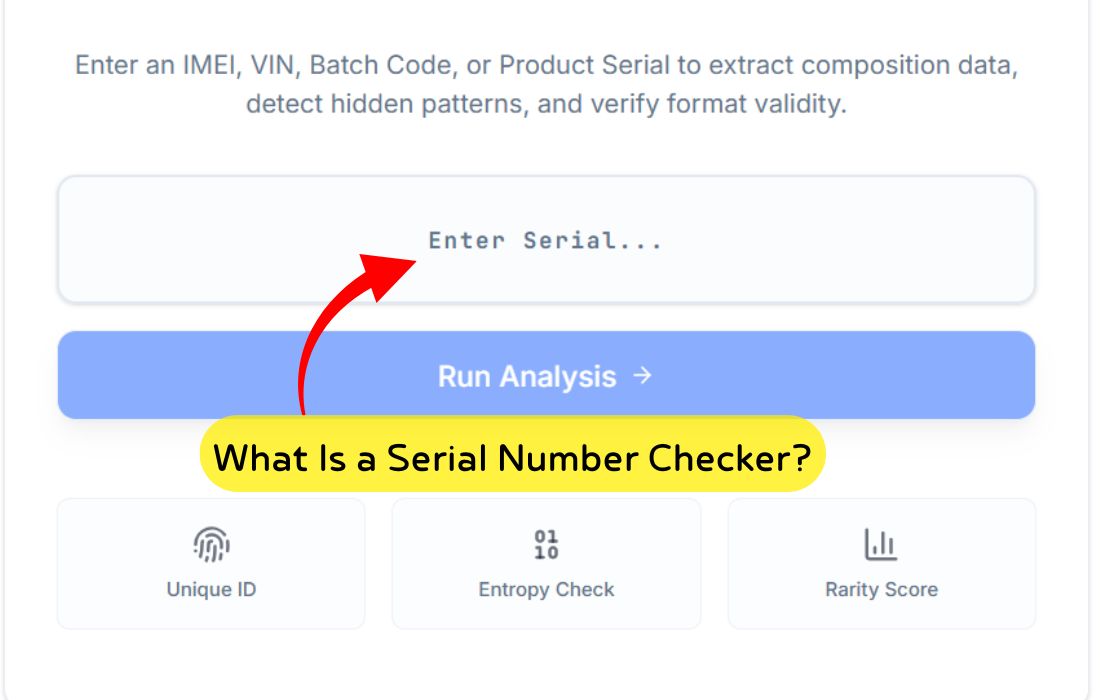
This guide will walk you through the anatomy of a serial number, the red flags you can spot with the naked eye, and how advanced tools like the Fancy Serial Number Checker can do the heavy lifting for you.
Table of Contents
What is a Serial Number and Why Do Fakes Exist?
Before you can catch a thief, you have to think what is serial number. A serial number is a unique identifier assigned incrementally or sequentially to an item. It is the item’s fingerprint.
Scammers create fake serial numbers for three main reasons:
- To Legitimize Counterfeits: A fake Rolex looks more real if it has a number engraved on the case.
- To Unlock Software: Key generators (keygens) create strings of code that trick software into thinking it has been purchased.
- To Increase Value: In the world of banknotes, “fancy” serial numbers (like 88888888) fetch high prices. Altering a standard bill to look like a “fancy” one is a common fraud.
The Anatomy of a Fake: What They Look Like
Identifying a serial number often comes down to spotting inconsistencies. Manufacturers use precise, industrial-grade machines to print or engrave these codes. Counterfeiters often use cheaper alternatives.
1. The Font and Typography
Genuine manufacturers use proprietary fonts. A fake serial number might use a standard font like Arial or Times New Roman because the counterfeiter didn’t have access to the custom typeface.
- Look for: Uneven spacing between numbers (kerning issues).
- Look for: “Bleeding” ink where the numbers look fuzzy at the edges.
2. The Application Method
- Genuine: Often laser-etched, deeply engraved, or printed with high-quality thermal transfer.
- Fake: Often a cheap sticker, lightly scratched on, or printed with a standard inkjet printer.
3. The Logic Error
Most serial numbers follow a mathematical algorithm (like the Luhn algorithm). They aren’t random. They contain date codes, factory codes, and batch numbers.
- The Fake: Often a random string of numbers that looks complex but fails a logic check.
7 Warning Signs: The Ultimate Red Flag Checklist
When checking serial authenticity, keep this checklist handy. If you spot more than one of these, proceed with extreme caution.
- [ ] The “Ghost” Sticker: Is the serial number printed on a sticker that is peeling up at the corners? High-end electronics rarely use cheap paper stickers for ID tags.
- [ ] The Duplicate: If you search the serial number on Google and find forum posts from 2018 sharing the exact same number, it’s a fake serial number.
- [ ] The Typos: Are there misspellings near the serial number? (e.g., “Manufacured in China” or “Serial No”).
- [ ] The “O” vs. “0” Confusion: Legitimate brands clearly distinguish between the letter ‘O’ and the number ‘0’. Fakes often mix them up or use the wrong character format.
- [ ] Incorrect Format: If a legitimate Apple serial number is typically 12 characters, and yours is 15, it is fake.
- [ ] Location, Location, Location: Is the number in the wrong spot? Consult the manufacturer’s website to see exactly where the code should be hidden.
- [ ] Too Perfect (Currency): For banknotes, if the serial number looks painted on or slightly raised/altered to create a “solid” number (e.g., changing a 3 to an 8), it is a red flag.
Real vs. Fake: Examples by Industry
To help you detect fake codes, let’s look at specific industries where this is rampant.
Electronics (Phones, Headphones, Chargers)
- Genuine: The serial number on the box matches the serial number in the device’s “Settings” menu AND the number printed physically on the device.
- Fake: The number on the box is real (copied from a legit box), but the device itself has a different number or no number at all.
Luxury Goods (Bags and Watches)
- Genuine: Watches often have serial numbers engraved between the lugs or on the movement. Handbags have “date codes” stamped on leather tags inside pockets.
- Fake: The engraving is shallow, rough to the touch, or the leather tag looks glued on rather than stitched.
Software Keys
- Genuine: A unique alphanumeric string that activates on the vendor’s server.
- Fake: A “Volume License Key” meant for corporations that is sold to individuals. It works for a week, then gets blacklisted.
![Graphic showing a software activation screen. One side shows 'Activation Successful', the other shows 'Key Invalid / Blocked'.]](https://checkfancyserialnumber.com/wp-content/uploads/2025/12/Whisk_f9158aa1e4af02c9f6a4ce50c2fa770bdr.jpeg)
How “Fancy Serial Number Checker” Detects Fake Serials
In the world of currency and complex algorithms, manual checks aren’t enough. This is where tools like the Fancy Serial Number Checker become essential.
While originally designed to identify rare and valuable patterns in banknotes, these advanced checkers are powerful tools to detect fake codes because they rely on algorithmic verification.
How It Works:
- Pattern Recognition: The tool analyzes the string for anomalies. If a user inputs a serial number that claims to be from a 2013 series bill but the serial number format corresponds to a 1996 series, the checker flags it.
- Algorithmic Validity: Many serial numbers (especially on money and credit cards) use “checksums.” The last digit is calculated based on the previous digits. If a counterfeiter changes a number to make it look “fancy” (e.g., changing a 12345671 to 12345678), the math won’t add up. The Fancy Serial Number Checker runs this math instantly.
- Database Cross-Referencing: Advanced versions of these tools can verify if a specific serial range was actually issued or if it falls into a “known counterfeit” range.
Why use a Serial Number Checker?
- Speed: Checks complex math in milliseconds.
- Accuracy: Eliminates human error.
- Peace of Mind: Provides a pass/fail result based on data, not guesses.
Step-by-Step Guide: How to Verify a Serial Number
Ready to check your item? Follow this workflow to verify serial authenticity.
Step 1: Locate the Number
Find the number on the item. Do not rely solely on the packaging. You must see the number on the product itself (under the battery, on the movement, on the software interface).
Step 2: The Visual Inspection
Use a magnifying glass or your phone camera’s macro mode.
- Is the ink consistent?
- Are the edges of the characters sharp?
- Does it look tampered with?
Step 3: The “Two-Place” Rule
Check if the serial number appears in two places.
- Example: For a phone, check the back of the phone AND the software settings (Settings > General > About).
- The Test: Do they match perfectly? If no, it is likely a refurbished housing or a fake.
Step 4: Use a Serial Number Checker
Input the code into a reputable serial number checker or the manufacturer’s official lookup tool (e.g., Apple Check Coverage, PCGS for currency).
- If using Fancy Serial Number Checker: Enter the digits carefully. Look for flags regarding “Invalid Range” or “Checksum Error.”
Step 5: Google It
Type the serial number into Google in quotation marks (e.g., “SN: 123456789”).
- Result: If you see results leading to AliExpress, eBay listings from 3 years ago, or pastebin sites, you have a fake serial number. Unique numbers should not appear publicly on the web.
What to Do If You Find a Fake
If your investigation leads you to believe you have a counterfeit item, follow these steps immediately:
- Stop Using It: If it’s electronics, it could be a fire hazard. If it’s software, it could be malware.
- Document Everything: Take screenshots of the serial number checker results, photos of the fake number, and keep your purchase receipt.
- Contact the Seller: Request a refund immediately, citing “counterfeit goods.”
- Report It: Notify the platform (eBay, Amazon) and the actual manufacturer.
Frequently Asked Questions (FAQs)
1. Can a fake product have a real serial number?
Yes. This is called “Cloning.” Counterfeiters copy a valid serial number from a real product and print it on thousands of fakes. However, you can usually spot this because the product quality won’t match, or the warranty date will be incorrect (e.g., showing the product was bought 2 years ago).
2. Is there a universal serial number checker?
No. Every manufacturer uses their own algorithm. However, tools like Fancy Serial Number Checker are excellent for currency, while brands like Apple, Dell, and Sony have their own specific lookup pages.
3. Why is my serial number not recognized by the website?
This usually means one of two things: the item is very new and the database hasn’t updated, or, more likely, it is a fake serial number.
4. Can I get in trouble for having a fake serial number on software?
Yes. If you use pirated software with a fake serial, the company can disable your software, deny you updates, or in corporate settings, sue for damages.
5. How do I check if a banknote serial number is fake?
Look at the font quality and alignment. Use a UV light to check for hidden security strips. Finally, run the digits through a dedicated currency checker to ensure the serial corresponds to the correct Federal Reserve Bank and print year.
6. What is a “Checksum”?
A checksum is the final digit in a sequence used to verify the validity of the previous numbers. If you alter the numbers without altering the checksum correctly, the code becomes mathematically invalid.
7. Are refurbished items considered “fake”?
No. Refurbished items are genuine products that have been repaired. They may have a new serial number issued by the repair center, but they are authentic.
8. Can I identify a fake just by the serial number? Often, yes. If the font is wrong, the format is invalid (too short/long), or the logic fails, the serial number alone is proof of a counterfeit.
9. What if the serial number is scratched off?
This is a major red flag. Stolen goods often have serial numbers removed. Do not buy items with removed serials; manufacturers will not service them.
10. Do all products have serial numbers?
Most high-value mass-produced goods do. Low-cost items (like a generic $5 cable) may not. However, luxury goods, electronics, and appliances always should.
Conclusion
The serial number is the DNA of your product. While counterfeiters are getting better at mimicking the physical look of products, they often cut corners when it comes to the complex data and printing quality of the serial number itself.
By paying attention to the print quality, cross-referencing with official databases, and using tools like the Fancy Serial Number Checker, you can protect yourself from fraud.
Next Step: Do you have an item you are suspicious of right now? Locate the serial number and try the “Google Test” (Step 5) immediately to see if that unique number appears on public websites!