Imagine paying $1,200 for a “brand new” MacBook Pro. Then, weeks later, it crashes. Apple won’t help you because the serial number links to a device reported stolen three years ago.
You are not alone. Global e-commerce fraud losses may reach $107 billion by 2029. Refund abuse and counterfeit electronics will make up a big part of that. In 2024, merchants and buyers already lost over $44 billion to clever fraudsters.
The serial number is like your device’s “fingerprint.” Scammers understand this, so they have learned to forge, clone, and change these numbers. They do this to sell you fake, stolen, or broken tech.
This guide shows you how scammers work. It also explains how to use serial number verification to protect your next purchase.
Table of Contents
How Scammers Weaponize Fake Serial Numbers
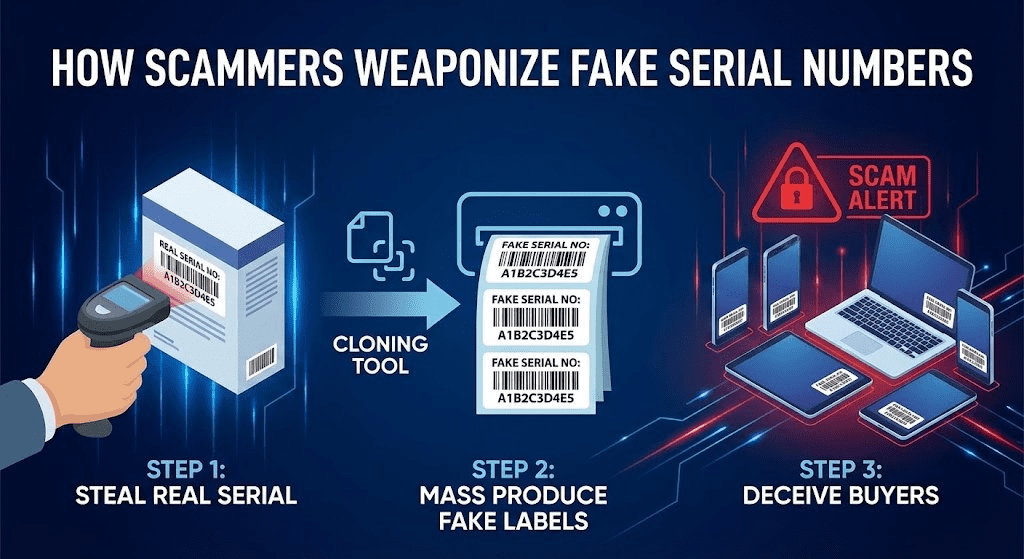
A serial number (S/N) or IMEI is supposed to be a unique identifier.4 However, scammers use three sophisticated methods to fool buyers:
1. The “Cloning” Technique
Scammers take a valid serial number from a genuine, working device (often one on display in a store) and print it onto the stickers of dozens of fake or broken units.5 When you run a basic check, the manufacturer’s website says “Valid Purchase Date,” lulling you into a false sense of security.
2. The “Frankenstein” Swap
A scammer buys a high-end laptop, swaps out the expensive internal components (RAM, SSD, Graphics Card) for cheap ones, and then returns it or resells it. The sticker on the bottom matches the high-end box, but the machine inside is a dud.
3. The Digital Spoof
On rooted Android phones or jailbroken iPhones, scammers can change the software. This lets them show a fake serial number in the “Settings” menu. You check the settings, and they match the box. But the phone might be a blacklisted prototype or a cheaper model posing as a flagship.
Real-World Scams: What to Watch For
📱 Smartphones (The “Clean IMEI” Trap)
The Scam: You buy a “sealed” iPhone 15 Pro Max on a marketplace. The IMEI on the box scans as “Clean/Not Blacklisted.”
The Reality: The phone inside is a realistic Android clone with an iOS skin. The IMEI on the box was simply copied from a real iPhone.
Red Flag: The device feels lighter than usual, or the “App Store” opens the Google Play Store.
💻 Laptops (The Warranty Illusion)
The Scam: You buy a “New Open Box” Dell XPS. The Service Tag sticker says it has a 3-year warranty.
The Reality: The scammer printed a fake label. The actual motherboard belongs to a 5-year-old refurbished unit with no warranty left.
Red Flag: The font on the bottom sticker looks slightly different from official branding.
📸 Cameras (The Grey Market Pivot)
The Scam: You buy a Canon or Sony camera for 20% less than retail. The serial number looks real.
The Reality: It is a “Grey Market” import meant for a different country. When it breaks, the local service center refuses to repair it because the serial number is not registered for your region.
Step-by-Step: How to Verify Before You Buy
Never rely on the sticker alone. Follow this “Triangle Check” to ensure the device is legitimate. Learning how to identify fake serial numbers is no longer just a skill for experts; it is a necessity for anyone buying pre-owned goods, collecting rare items, or purchasing gray-market software.
Step 1: The Physical Check
Locate the serial number printed on the device hardware (back of the phone, bottom of the laptop, or near the battery).6
- Tip: Rub the sticker gently. If the ink smears or the sticker corners peel easily, walk away.
Step 2: The Software Cross-Reference
Power on the device and find the internal serial number to see if it matches the physical sticker.
- iPhone: Settings > General > About
- Android: Settings > About Phone > Status
- Windows Laptop: Open Command Prompt (CMD) and type: wmic bios get serialnumber
- MacBook: Click the Apple Logo (top left) > About This Mac7
Step 3: The Database Lookup
Enter the result into the official manufacturer’s verification tool:
- Apple: checkcoverage.apple.com
- Samsung/Android: IMEI.info
- Dell: dell.com/support (Service Tag lookup)8
- HP: support.hp.com/checkwarranty
Comparison Table: Genuine vs. Fake Electronics
| Feature | Genuine Device | Counterfeit / Scammed Device |
| Serial on Sticker | High-quality print, hard to peel, aligns perfectly. | Blurry text, crooked placement, “paper” feel. |
| Software Match | BIOS/Settings match the sticker exactly. | Software shows “Unknown” or a completely different number. |
| Manufacturer Check | Returns correct model, color, and warranty date. | Returns “Invalid Serial,” wrong color, or expired warranty. |
| Pricing | Consistent with market value. | “Too good to be true” (e.g., 50% off new models). |
| Box Quality | High-resolution images, correct spelling. | Faded images, typos (e.g., “Samsnug”), missing manuals. |
A Note on the “Fancy Serial Number Checker”
You may have encountered a tool called the Fancy Serial Number Checker in your research. It is important to distinguish its use case to avoid confusion.
What is it?
The “Fancy Serial Number Checker” is a famous tool designed for currency collectors (numismatists). It scans the serial numbers on dollar bills to find rare patterns (like solid 8s, ladders like 12345678, or repeaters) that make a bill worth more than its face value.9
Can it help with Electronics Scams?
Directly? No. This tool does not verify iPhones or Laptops.
Indirectly? Yes.
If you are conducting a cash transaction for electronics (e.g., buying a used GPU or phone via Craigslist), you are vulnerable to two types of scams: fake devices AND fake money.
- For the Buyer: If a seller insists on cash, double-check your own bills. Scammers sometimes accuse you of paying with fakes to get the item back + your cash.
- For the Seller: If you are selling electronics for cash, use the concept of “fancy” checking to inspect the bills handed to you. While not an electronic verification tool, it is a financial verification habit that adds a layer of safety to face-to-face exchanges.
Pro Tip: For electronics, stick to IMEI.info, Swappa, or the manufacturer’s own site. Do not use currency tools to validate a MacBook.
Frequently Asked Questions (FAQs)
1. Can a fake iPhone have a real serial number?
Yes. Scammers use “cloned” serial numbers stolen from real iPhones.10 This is why you must check if the serial number in the Settings menu matches the one on the box.
2. Is it safe to give a seller my serial number to check warranty?
Be cautious. If you share your serial number publicly (e.g., in an eBay listing photo), scammers can clone it. Only share it with a serious buyer privately.
3. What is the difference between IMEI and Serial Number?
The Serial Number identifies the specific device manufacturing batch.11 The IMEI (International Mobile Equipment Identity) specifically connects phones to cellular networks. Both should be verified.
4. How do I check if a phone is stolen?
Use a tool like CTIA Stolen Phone Checker or IMEI.pro. These databases track devices reported lost or stolen by carriers.
5. Can a factory reset change the serial number?
No. A factory reset wipes data but leaves the hardware identifiers (Serial/IMEI) intact. If the number changes after a reset, the device was likely “spoofed” (hacked) previously.
6. What does “Grey Market” mean in serial number checks?
It means the device is real but was imported from another region (e.g., a Japanese camera sold in the US). Manufacturers may deny warranty repairs for these items.
7. Why does my Dell Service Tag not show up on the website?
If the laptop is brand new, it might take a few days to register. However, if it is a used device and the tag is unrecognized, it is likely a fake sticker or a replaced motherboard.
8. Can I trust “Refurbished” electronics serial numbers?
Only if bought from certified refurbishers (like Apple Certified or Dell Outlet). Third-party “refurbs” may contain mixed parts that don’t match the original serial specifications.
9. What should I do if I bought a device with a fake serial number?
Immediately file a claim with the platform (eBay, PayPal, Credit Card). Provide photos of the mismatch between the software serial number and the physical sticker as evidence of fraud.