In a global economy defined by complex supply chains and digital transactions, the line between a legitimate product and a counterfeit one is often razor-thin. Whether it is a life-saving medical device, a high-end luxury watch, or a critical automotive component, the integrity of the entire system rests on a single, alphanumeric string: the serial number.
Serial number verification is no longer just a boring inventory task; it is a fundamental pillar of modern commerce, safety, and legal compliance. As markets grow more crowded, the risk of counterfeits, gray market diversion, and mismanagement escalates. Industries today rely on robust verification processes not just to track boxes, but to ensure product traceability, protect brand reputation, and guarantee consumer safety.
This guide explores the seven major sectors where verification is mandatory, explains the mechanics behind it, and introduces how versatile tools like Fancy Serial Number Checker provide the multi-industry insights required to maintain trust in a digital world.
Table of Contents
What Is Serial Number Verification?
At its core, serial number verification is the process of authenticating a unique identifier assigned to a specific item to confirm its legitimacy, origin, and history.
Think of a serial number as a product’s DNA. Unlike a model number (which identifies a type of product) or a batch number (which identifies a production run), a serial number is the unique fingerprint of a single unit. No two should ever be the same.
Why It Matters
Verification serves as the bridge between the physical product and digital records. It allows manufacturers, retailers, and consumers to “ping” a database to answer critical questions: Is this real? Is it stolen? Is it still under warranty?
Without verification, the link between a manufacturer and the end-user is broken, creating blind spots where counterfeits and defective products thrive.
The Language of Logistics: Key Identifiers
| Identifier Type | Definition | Primary Purpose |
| Serial Number | A unique code assigned to one specific unit. | Individual identification & tracking. |
| Model Number | A code shared by all products of the same design. | Identifying features & compatibility. |
| Batch/Lot Number | A code for a group of items made at the same time. | Quality control & expiration tracking. |
| IMEI / VIN | Industry-specific versions of serial numbers. | Network (phones) or Vehicle registration. |
Why Serial Numbers Are Critical for Modern Industries
Before looking at specific sectors, it is essential to understand the universal pressures driving the need for rigorous serial number verification. It usually boils down to safety, money, and law.
1. Anti-Counterfeit Protection
Counterfeiting is a multi-trillion-dollar underground economy. Verification allows consumers and businesses to instantly spot fakes. If a serial number is invalid, duplicated, or does not match the product specifications, it acts as an immediate red flag.
2. Supply Chain Transparency
From the factory floor to the retail shelf, product traceability is key. Serial numbers create a digital breadcrumb trail, ensuring that goods haven’t been diverted to unauthorized markets (the “gray market”) or tampered with during transit.
3. Warranty and Service Tracking
Manufacturers lose millions annually to fraudulent warranty claims. Verification ensures that service is only provided to eligible units, confirming the purchase date and ownership status before repairs begin.
4. Regulatory Compliance & Recalls
When a safety defect is discovered, a broad recall is expensive and damaging. Serial numbers allow for “surgical” recalls—targeting only the specific units affected—rather than recalling every product ever sold.
Top 7 Industries That Rely on Serial Number Verification
While almost every sector uses inventory tracking, the following seven industries depend on serial verification for safety, legality, and high-stakes financial protection.
1. Electronics
The consumer electronics market is the most volume-heavy user of serial verification, dealing with everything from smartphones and laptops to smart home appliances.
- Why It’s Essential: High unit costs and high resale values make electronics a prime target for theft and counterfeiting.
- How It Is Used:
- IMEI Checks: For smartphones, the IMEI (International Mobile Equipment Identity) determines if a phone is blacklisted, reported stolen, or locked to a specific carrier.
- Warranty Validation: Companies require serial checks to process warranties or AppleCare, ensuring the device isn’t gray-market stock.
- The Risk: Without verification, consumers often buy “Frankenstein” phones assembled from mismatched parts or stolen devices that are later bricked by carriers.
- Role of Fancy Serial Number Checker: It helps users quickly parse and validate complex alphanumeric strings found on devices, helping distinguish between standard serials and distinct formats like IMEI or MEID.
2. Automotive
The automotive industry relies on the Vehicle Identification Number (VIN) and individual component serials to manage safety and ownership.
- Why It’s Essential: A car is a lethal machine if it malfunctions. Tracking parts is a matter of life and death.
- How It Is Used:
- VIN Decoding: This reveals the car’s manufacturer, engine type, and assembly plant.
- Parts Authentication: High-value parts like airbags, ECUs, and transmission blocks have serials to prevent the installation of unsafe, salvaged components.
- The Risk: “VIN Cloning”—where criminals copy VINs from legal cars to mask stolen ones—is a major issue. Additionally, during recalls (like the massive airbag crisis), serial verification is the only way to know which specific cars are dangerous.
- Role of Fancy Serial Number Checker: Assists in verifying part numbers and component serials during maintenance or restoration to ensure compatibility and authenticity.
3. Software & Digital Products
In the digital realm, the “product” is code, and the serial number is the License Key.
- Why It’s Essential: Unlike physical goods, software can be copied infinitely at zero cost. Serial keys are the only barrier to piracy.
- How It Is Used:
- Activation: The software “phones home” to verify the key hasn’t been used on more devices than allowed.
- Subscription Management: Links a specific user account to a paid license duration.
- The Risk: “Keygen” programs generate fake serials to bypass payment, or one legitimate key is shared illegally across hundreds of computers, causing massive revenue loss for developers.
- Role of Fancy Serial Number Checker: Can be used to check the structural validity of license keys, ensuring they follow the correct alphanumeric pattern before attempting activation.
4. Manufacturing
Manufacturing acts as the source of truth for all other industries, requiring intense product traceability.
- Why It’s Essential: Manufacturers must track raw materials entering the factory and finished goods leaving it to maintain ISO compliance.
- How It Is Used:
- Batch Control: Linking individual unit serials to specific raw material batches.
- Defect Tracking: If a machine malfunctions on Tuesday, the manufacturer can identify every serial number produced on that shift.
- The Risk: Without serialization, a single defect can lead to mass waste, as the manufacturer cannot isolate the bad units from the good ones.
- Role of Fancy Serial Number Checker: Supports quality assurance teams by validating that printed serials on the assembly line meet the required formatting standards before packaging.
5. Medical Devices
This is perhaps the most regulated sector. From pacemakers to MRI machines, traceability is a strict legal requirement.
- Why It’s Essential: Patient safety. If a device fails, hospitals must know exactly which patient has it inside them or near them.
- How It Is Used:
- UDI (Unique Device Identification): A global system for identifying medical devices through distribution and use.
- Sterilization Tracking: Verifying that a specific surgical tool went through the correct sterilization cycle before surgery.
- The Risk: Expired implants being used in surgery or counterfeit surgical mesh entering the supply chain can lead to fatal outcomes.
- Role of Fancy Serial Number Checker: Provides a quick check mechanism for hospital inventory managers to ensure device IDs match records before deployment.
6. Tools & Industrial Equipment
Heavy machinery and power tools are high-value assets often subject to theft and harsh working conditions.
- Why It’s Essential: Asset management, theft recovery, and maintenance safety.
- How It Is Used:
- Fleet Management: Construction companies track the location and maintenance history of excavators via serials.
- Warranty Claims: Verifying that a broken drill is still within the coverage period and hasn’t been tampered with.
- The Risk: Job site theft is rampant. Thieves often scrub serials to resell tools. Furthermore, using equipment past its rated service life risks injury to workers.
- Role of Fancy Serial Number Checker: Helps buyers of used industrial equipment verify that the serial number format aligns with the manufacturer’s standards, flagging potential tampering.
7. Luxury Goods
For brands like Rolex, Chanel, or Louis Vuitton, the brand is the value. Serial numbers are the certificate of authenticity.
- Why It’s Essential: Protecting brand equity against “Superfakes.”
- How It Is Used:
- Resale Verification: The pre-owned luxury market relies entirely on serials to value items and prove they aren’t stolen.
- Databasing: High-end watches have serials recorded in internal archives detailing the exact production date and original retailer.
- The Risk: Buyers paying thousands for high-quality replicas, or “Franken-watches” containing generic movements inside genuine cases.
- Role of Fancy Serial Number Checker: Assists collectors and resellers in validating unique “fancy” serial numbers (e.g., repeating digits like 8888) which often command a higher premium.
Industry Comparison Table
Here is a quick breakdown of how priorities shift depending on the sector:
| Industry | Primary Purpose | Verification Importance | Risk of Counterfeit | Typical Use Cases |
| Electronics | Theft prevention & Warranty | Critical | High | Smartphones, Laptops, Consoles |
| Automotive | Safety & Recall Management | Critical | Medium | VINs, Airbags, ECUs |
| Software | Piracy Prevention | High | High (Digital) | License Keys, Subscriptions |
| Manufacturing | QA & Traceability | High | Low (Internal) | Raw Materials, Batch Tracking |
| Medical | Patient Safety & Compliance | Mandatory | Low (Regulated) | Implants, Surgical Tools |
| Industrial | Asset Management | Medium | Medium | Power Tools, Heavy Machinery |
| Luxury | Authenticity & Value | High | Very High | Watches, Bags, Jewelry |
How Fancy Serial Number Checker Supports Multiple Industries
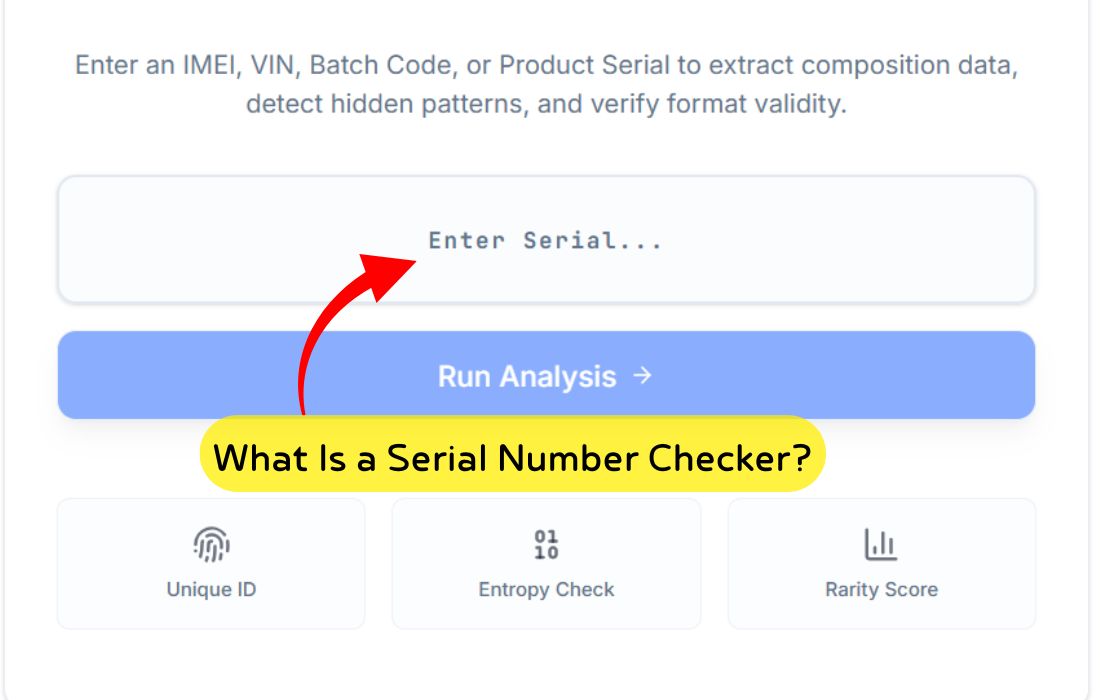
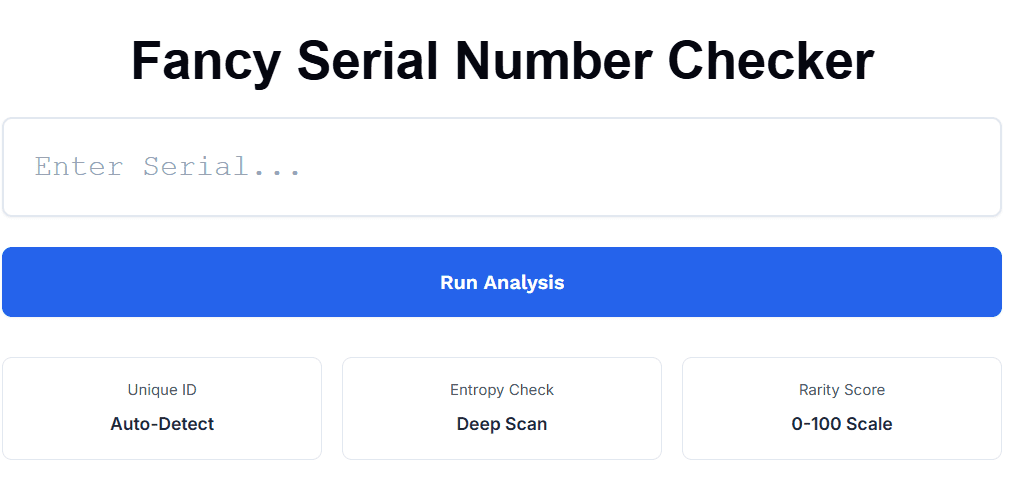
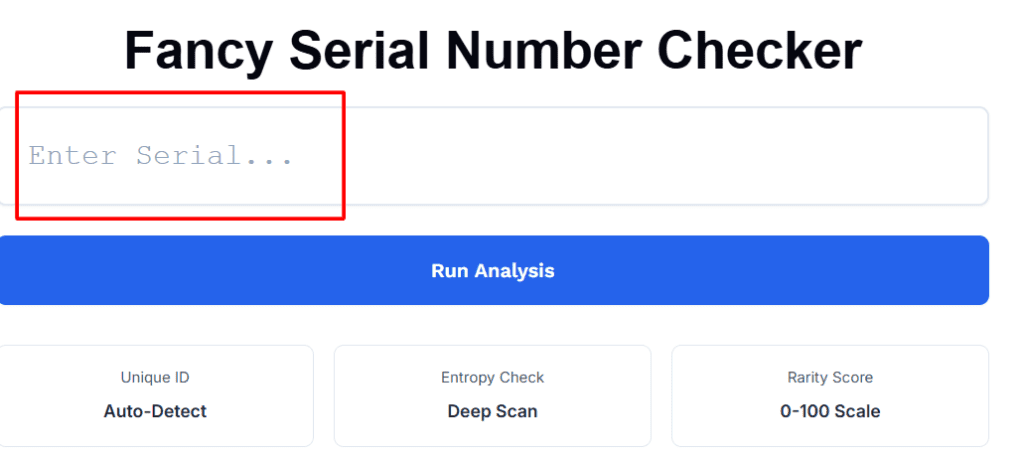
Fancy Serial Number Checker is designed to address the complexity of modern identification systems. While many tools are locked to a single niche, this solution offers cross-industry adaptability by focusing on the structure and logic of the data.
- Multi-Format Recognition: Whether it is a 17-digit VIN, a 15-digit IMEI, or a complex alphanumerical software key, the tool’s algorithms are tuned to recognize and validate diverse structures.
- Pattern Validation Logic: The checker doesn’t just look at the number; it looks at the logic behind it. It helps identify “fancy” patterns (like solid blocks of numbers, radars, or repeaters) that are valuable in the currency and collectibles markets, while also flagging format errors in industrial contexts.
- Privacy-First Architecture: In industries like medical and software, data privacy is paramount. This tool is built to process input without unnecessary data retention, ensuring that sensitive serials remain secure.
How to Choose the Right Serial Number Checker
Selecting the right tool depends on your specific industry needs. Here is what to look for:
- Accuracy & Logic: Does the tool understand the specific format of your industry (e.g., does it know the Luhn algorithm for IMEIs)?
- Versatility: Can it handle multiple types of serials, or is it a “one-trick pony”?
- Speed: For business users checking inventory, instant results are non-negotiable.
- Security: Ensure the tool does not harvest your serial numbers for malicious use.
Why Fancy Serial Number Checker?
It strikes the balance between depth and ease of use. It is sophisticated enough to detect complex patterns for collectors and robust enough to validate standard formats for general industry verification. It removes the guesswork, providing a “second opinion” on the validity of any alphanumeric string.
FAQs: Common Questions About Serial Verification
Which industries use serial numbers the most?
The Electronics and Automotive industries are the heaviest users due to the high volume of goods, high theft risks, and strict regulatory requirements for safety and warranty tracking.
Why is serial number verification important for consumers?
It protects you from fraud. Verifying a serial number ensures you aren’t buying a stolen, counterfeit, or recalled item, and guarantees that your warranty is valid.
Can one tool work for all industries?
While some industries have proprietary databases (like police stolen vehicle databases), a universal pattern validator like Fancy Serial Number Checker is effective for checking the structure and format validity of serials across different sectors.
How does serial verification prevent counterfeits?
Counterfeiters often guess serial numbers or print the same number on thousands of units. Verification tools can flag invalid formats or duplicate numbers that have already been registered, exposing the fakes.
Is Fancy Serial Number Checker suitable for businesses?
Yes. Its ability to quickly validate patterns and formats makes it a useful utility for pawn shops, resellers, and inventory managers who need to spot anomalies in product IDs quickly.
Conclusion: Verify with Confidence
In a world filled with complex supply chains and sophisticated counterfeits, trust is a currency you cannot afford to lose. From ensuring a medical device is safe for a patient to guaranteeing a luxury watch is genuine, serial number verification is the invisible shield protecting modern commerce.
Don’t leave authenticity to chance. Whether you are a business managing inventory, a collector hunting for rare serial patterns, or a consumer buying used electronics, validating the ID is the first step in securing your investment.