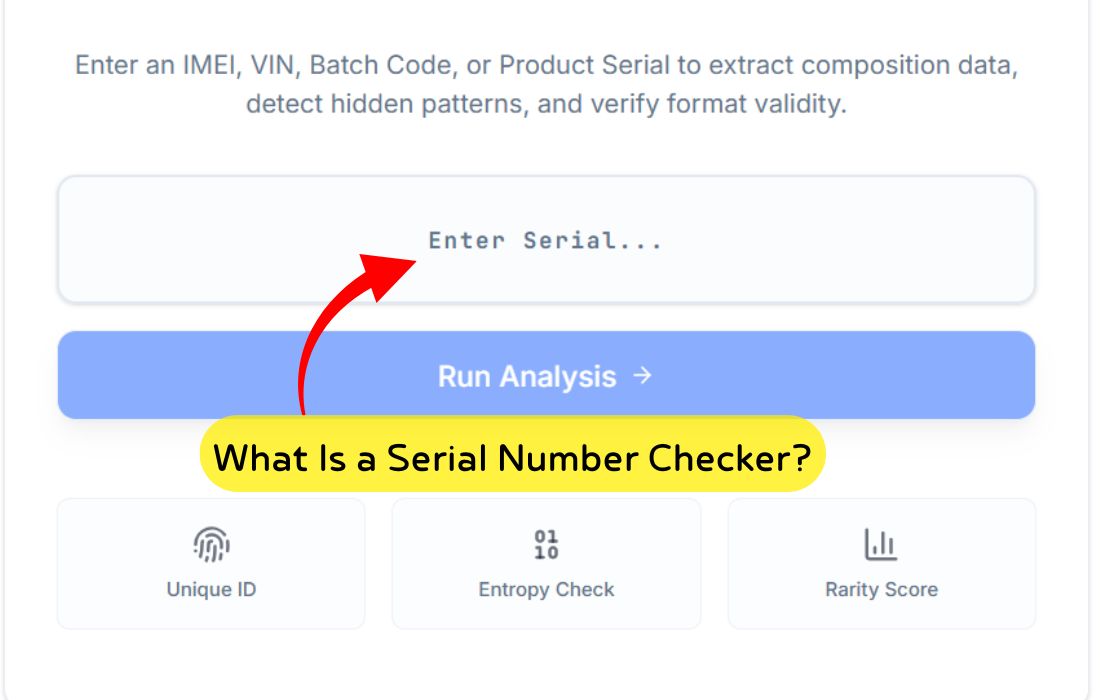
When you are about to buy a pre-owned smartphone, a vintage luxury bag, or a collectible bank note, verifying the authenticity is crucial. You find a tool online, you locate the serial number on your item, and your finger hovers over the “Check” button.
But then, you pause.
- Is this safe?
- Will this website steal my product information?
- Could someone use this serial number to claim my device?
These are valid, necessary questions. In an era where data leaks and digital privacy violations are common headlines, hesitation is a healthy instinct. The reality is that while the internet is full of useful tools, not all of them treat your data with respect.
However, online serial number checking is safe when done correctly, using transparent, privacy-first tools.
This guide will walk you through exactly how secure serial number lookups work, what risks actually exist (and which ones are myths), and how platforms like Fancy Serial Number Checker have built their infrastructure to prioritize user safety and data anonymity.
Table of Contents
Why People Worry About Online Serial Number Checkers

The fear of entering a unique identifier into a web form stems from a lack of control. Once you press “Submit,” you don’t know where that data goes. Let’s look at the genuine concerns users face regarding online serial number checking.
1. The Fear of Data Misuse (Cloning)
The most common worry is “cloning.” Users fear that if a bad actor gets a valid serial number, they can apply it to a counterfeit product to make it look legitimate. While this is a real technique used by fraudsters, a passive lookup tool generally does not facilitate this—public forums where people post photos of their serial numbers are a much higher risk.
2. Privacy and User Tracking
Many free online tools monetize by harvesting user data. Users worry that by entering a serial number, the website will link that product to their IP address, location, or browser cookies, effectively building a profile of “who owns what.”
3. “Stealing” Ownership or Warranty
There is a prevailing fear that checking a serial number on a third-party site might somehow “register” the device to the website owner or, conversely, void the manufacturer’s warranty by flagging the number as “checked.”
4. Malicious Websites
Not all websites are legitimate. Some are phishing sites designed to look like official manufacturer portals (like Apple or Samsung) to trick users into entering not just serial numbers, but Apple IDs or passwords.
Key Takeaway: The risk usually isn’t the act of checking the number itself; the risk lies in where you are checking it and what else the site asks you to provide.
What Data Does a Serial Number Checker Actually Use?
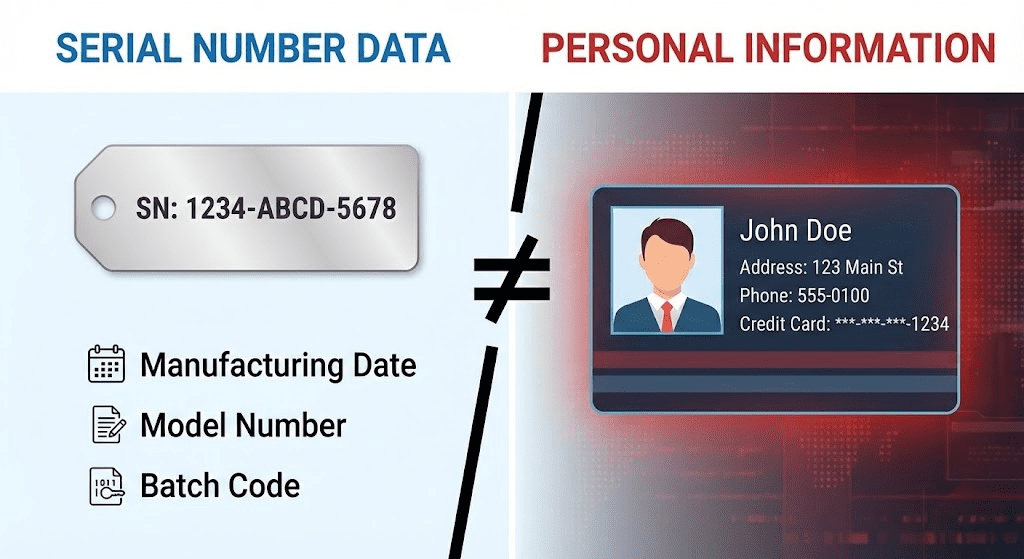
To understand if a secure serial lookup is possible, we must first understand what a serial number actually is.
A serial number is a manufacturing string. It is a code that tells the story of the product’s creation. It is not a password, and it is not biometric data.
What a Serial Number Contains:
- Manufacturing Location: Which factory built the item.
- Date of Production: The week and year it was made.
- Model Number: The specific configuration (e.g., iPhone 12, Blue, 128GB).
- Batch Number: The specific production run.
What a Serial Number Does NOT Contain:
- Owner’s Name: It does not know who bought it.
- Billing Address: It is not linked to your credit card.
- Current GPS Location: It cannot track where the item is.
- User Content: It has no access to photos, messages, or files inside the device.
Comparison: Serial Number vs. Personal Information
| Feature | Serial Number | Personal Information (PII) |
| Nature of Data | Manufacturing Data | Identity Data |
| Link to Person | No (unless registered manually) | Yes (Direct link) |
| Sensitivity | Low to Medium | High |
| Risk if Leaked | Potential for counterfeiting | Identity theft, financial loss |
| What Checkers See | “Item X made in 2021” | “John Doe lives in NYC” |
When you use a tool like Fancy Serial Number Checker, the system is simply decoding the logic of the string. It reads the manufacturing code to tell you what the item is, not who owns it.
What Good Serial Number Checkers Do NOT Store
Trustworthy tools operate on a “Privacy by Design” principle. This means the system is architected to process data without retaining it. Here is what a safe, privacy-focused checker avoids:
1. No User Accounts Required
If a serial number checker asks you to create an account, verify your email, or link a social profile just to check a string of numbers, this is a red flag. Safe tools allow for anonymous, guest-based access.
2. No Serial History Storage
A privacy-first tool processes the serial number in real-time (often utilizing client-side logic or temporary server-side processing) and then discards the data. It does not build a database of “valid serial numbers entered by users.”
3. No IP Address Logging
While web servers technically see IP addresses to deliver the webpage, ethical tools do not associate your IP address with the specific serial number you entered. There is no log saying “IP Address 123.45 checked Serial ABC.”
4. No Resale of Data
Legitimate tools do not bundle your data to sell to third-party advertisers or insurance companies. The purpose of the tool is strictly informational.
Common Myths About Online Serial Number Checking (Debunked)
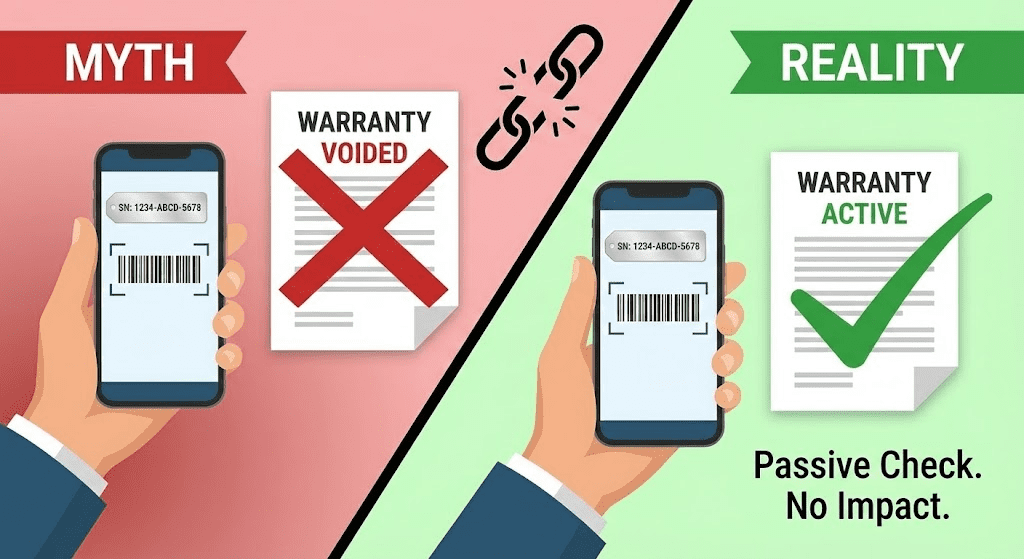
Misinformation spreads quickly. Let’s debunk the most common myths regarding serial checker privacy and safety.
Myth 1: “Checking a serial number voids the warranty.”
Reality: False. Warranties are held by the manufacturer. Checking a number on a third-party site is a passive action. The third-party site has no access to the manufacturer’s internal warranty database to change or void anything.
Myth 2: “If I check it, the website becomes the owner.”
Reality: False. Ownership is determined by purchase receipts and, in the case of electronics, iCloud or Google locks. A serial number is public manufacturing information; possessing or checking the number does not transfer legal ownership.
Myth 3: “Hackers can hack into my phone using the serial number.”
Reality: Highly Unlikely. A serial number alone is not a “backdoor” into a device. To hack a device, an attacker usually needs physical access, your password, or you must download malicious software. The serial number is just an ID tag.
Myth 4: “Online checkers are illegal.”
Reality: False. Decoding serial numbers is simply interpreting a standardized format. It is similar to translating a sentence from one language to another. It is a legal, informational process.
Myth 5: “The tool can tell me who the previous owner was.”
Reality: False. Unless the tool is a law enforcement database (which public tools are not), there is no way to retrieve names or addresses from a serial number string.
Myth 6: “All checkers sell your data to scammers.”
Reality: False. While some low-quality sites might use trackers, reputable tools like Fancy Serial Number Checker exist solely to help collectors and buyers verify information without malicious intent.
How Fancy Serial Number Checker Protects User Privacy
Fancy Serial Number Checkers was built to solve the trust gap in the market. We recognized that users wanted to verify fancy bank notes and currency serials without risking their privacy.
Here is how our infrastructure ensures your safety:
Zero-Retention Policy
We employ a strict no-logs policy regarding the specific serial numbers entered into our system. Once the calculation or analysis is displayed on your screen, the data is flushed from active memory. We do not store a historical list of what users have checked.
Secure Processing (SSL/TLS)
All data transmitted between your browser and our servers is encrypted using standard SSL (Secure Sockets Layer) technology. This ensures that no one on your Wi-Fi network or ISP can intercept the serial number you are checking.
Minimal Data Exposure
Our algorithms require only the serial number string. We do not ask for:
- Your name
- Your email
- Your location
- Photos of the item
Transparency Mapping
| Feature | Trust Benefit |
| No Login | You remain completely anonymous. |
| HTTPS Encryption | Your input cannot be intercepted. |
| Read-Only Logic | We analyze the number; we don’t modify any external databases. |
| Clear Results | We explain exactly what makes the serial number special/fancy. |
Security Best Practices for Users (Actionable Tips)
Even when using a safe tool, you should practice good digital hygiene. Here are actionable tips to verify serial numbers safely:
- Use HTTPS Only: Always look for the padlock icon in the browser address bar. If a site says “Not Secure,” do not enter any data.
- Avoid Sketchy Pop-ups: If a serial checker site is bombarded with aggressive ads, pop-ups, or “You have a virus” warnings, leave immediately.
- Don’t Share on Public Forums: Never post a photo of your device’s serial number on Twitter, Reddit, or eBay listings. This is where cloners actually get their numbers—not from checking tools, but from public photos.
- Verify Before You Buy: If you are buying a used item, ask the seller for the serial number and check it before handing over cash.
- Use Trusted Tools: Stick to tools that have clear privacy policies and a professional appearance, like Fancy Serial Number Checker.
- Cross-Reference: If the result looks impossible (e.g., a serial number claiming an iPhone 13 was made in 2015), the serial number may be fake.
- Incognito Mode: If you are extra paranoid, use your browser’s “Incognito” or “Private” mode. This prevents your local browser history from storing the site visit.
- Update Your Browser: Ensure your web browser is up to date to benefit from the latest security patches.
Transparency & Trust Signals That Matter
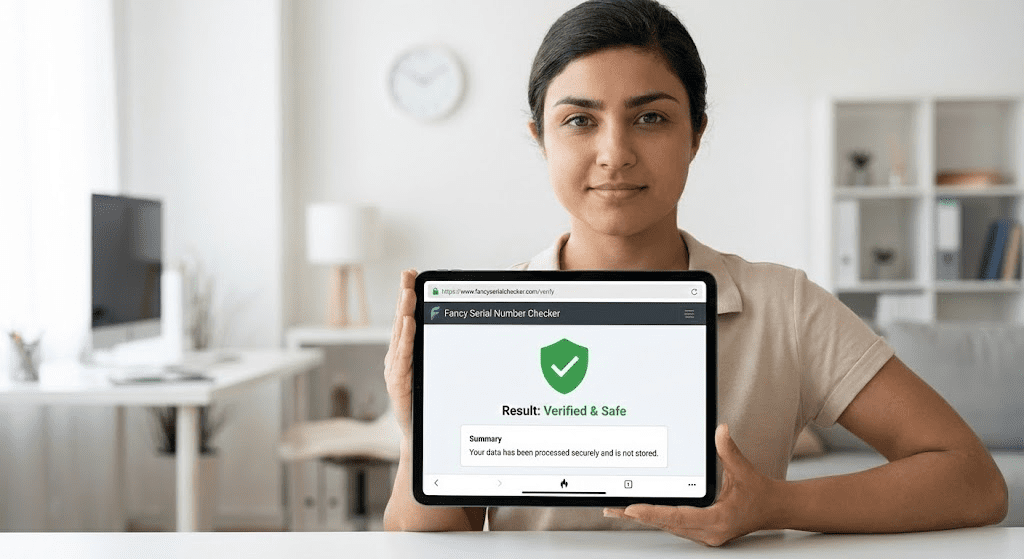
How can you tell if a website is trustworthy? In the world of cybersecurity, transparency is the ultimate trust signal. Legitimate tools have nothing to hide.
Why Transparency Improves Safety:
When a tool clearly states its limitations (e.g., “We cannot check if a phone is stolen, only when it was made”), it shows honesty. Scammers often promise impossible results (e.g., “Unlock iCloud instantly with Serial Number”) to lure victims.
Key Trust Signals of Fancy Serial Number Checker:
- Clear Privacy Policy: A comprehensive document accessible from the footer explaining data handling.
- No Hidden Fees: We don’t ask for credit card details halfway through the process.
- Educational Intent: Our goal is to help you understand the value of your serial number (especially for currency collectors), not to harvest data.
- Contact Options: A way to reach the developers or admins for feedback.
How to Identify a Safe Serial Number Checker
Before you type into any input box, run through this quick mental checklist. If a site fails more than one of these, find a different tool. Learning how to identify fake serial numbers is no longer just a skill for experts; it is a necessity for anyone buying pre-owned goods, collecting rare items, or purchasing gray-market software.
The “Safe Checker” Checklist:
- [ ] SSL Certificate: Does the URL start with
https://? - [ ] No Registration: Can you use the tool without signing up?
- [ ] Clean Interface: Is the site free of malicious-looking ads or “Download Now” buttons?
- [ ] Realistic Promises: Does the site avoid claiming it can “hack” or “unlock” devices?
- [ ] Privacy Policy: Is there a link to a privacy policy at the bottom of the page?
- [ ] Speed: Does the result appear instantly? (Scam sites often have fake “loading bars” to keep you on the page longer).1
Fancy Serial Number Checker checks every box on this list. We prioritize a clean, fast, and secure user experience.
FAQs regarding Online Serial Number Safety
Is online serial number checking safe?
Yes, it is safe as long as you use a reputable website that uses HTTPS encryption and does not require you to create an account or provide personal information.
Does the tool store my serial number?
Reputable tools like Fancy Serial Number Checker do not store your serial number history. The data is processed temporarily to provide the result and then discarded.
Can my serial number be misused if I check it online?
Simply checking it on a safe tool does not lead to misuse. The risk of misuse comes from sharing the serial number publicly on social media or forums where fraudsters can copy it.
Is Fancy Serial Number Checker secure?
Yes. We use standard encryption protocols, do not store user logs, and do not require registration. We focus on privacy and data minimization.
Can checking a serial number void my warranty?
No. Checking a serial number on a third-party website is a passive action. It does not communicate with the manufacturer’s warranty database and cannot alter your coverage.
What makes a serial number “Fancy”?
In the context of currency, a “Fancy” serial number involves unique patterns (like 12345678, 00000001, or repeating digits) that make the bill valuable to collectors.2 Our tool helps identify these patterns.
Can a serial number checker tell me if my device is stolen?
Generally, no. Most public checkers determine manufacturing dates and models. Theft databases (like the GSMA blacklist) are usually separate and may require different, specialized tools.
Conclusion
The internet requires caution, but it shouldn’t require fear. Online serial number checking is a valuable resource for collectors, buyers, and tech enthusiasts who need to verify authenticity and value.
The risks associated with serial numbers—such as cloning or data tracking—are largely avoidable by following simple best practices: never share your serials on public forums, use HTTPS-secured websites, and rely on transparent tools that respect your anonymity.
Fancy Serial Number Checker is committed to setting the standard for secure serial lookup. We believe in providing accurate, interesting data about your serial numbers without compromising your digital privacy. You do not need to trade your security for information.