Verifying a serial number before making a purchase or confirming authenticity can save you from costly mistakes. You need quick, reliable info whether you’re buying a used laptop, checking a power tool’s warranty, or validating software.
But here’s where it gets tricky: Should you check serial numbers yourself on manufacturer websites and via customer service calls, or rely on an online serial number checker to handle it?
Both methods have their place, but choosing the wrong approach can cost you time, money, or peace of mind. In this guide, we’ll break down both options, compare their strengths and weaknesses, and help you decide which method fits your needs best.
Table of Contents
What Is Manual Serial Verification?
Manual serial verification means checking a product’s serial number directly through official manufacturer channels without using automated tools or third-party services.
This traditional approach typically involves:
Manufacturer Websites: Visiting the official brand website and entering the serial number into their warranty or product registration portal. Companies like Apple, Dell, and Samsung offer dedicated lookup pages.
Customer Support: Calling or emailing the manufacturer’s support team to verify authenticity, warranty coverage, or manufacturing details.
Product Documentation: Cross-referencing serial numbers with original receipts, warranty cards, or packaging to confirm legitimacy.
People usually choose manual verification when dealing with high-value items, warranty claims, or situations requiring official documentation. It’s the go-to method for those who want information straight from the source.
Pros and Cons of Manual Serial Checks
Pros
- Direct Manufacturer Verification: You’re getting information from the official source, which eliminates middlemen and reduces the risk of inaccurate data.
- Official Documentation: Many manufacturers provide printable verification results that can be used for insurance claims, warranty disputes, or resale purposes.
- No Privacy Concerns: Your serial number stays between you and the manufacturer, with no third-party involvement.
- Comprehensive Information: When available, manufacturer portals often show detailed specifications, purchase dates, warranty expiration, and service history.
Cons
- Time-Consuming Process: Navigating manufacturer websites, waiting on hold for customer service, or waiting days for email responses can eat up significant time.
- Limited Accessibility: Not all manufacturers offer online verification. Some brands require you to contact support during business hours, which may not align with your schedule.
- Technical Knowledge Required: Understanding where to find serial numbers, which manufacturer website to use, or how to interpret results requires some product knowledge.
- Inconsistent Availability: Smaller brands or older products may lack verification systems entirely, leaving you with no manual option.
- Language Barriers: International manufacturers may have portals only in their native language or limited English support.
- Multiple Visits Required: Checking multiple products means visiting multiple websites with different interfaces and requirements.
What Is an Online Serial Number Checker?
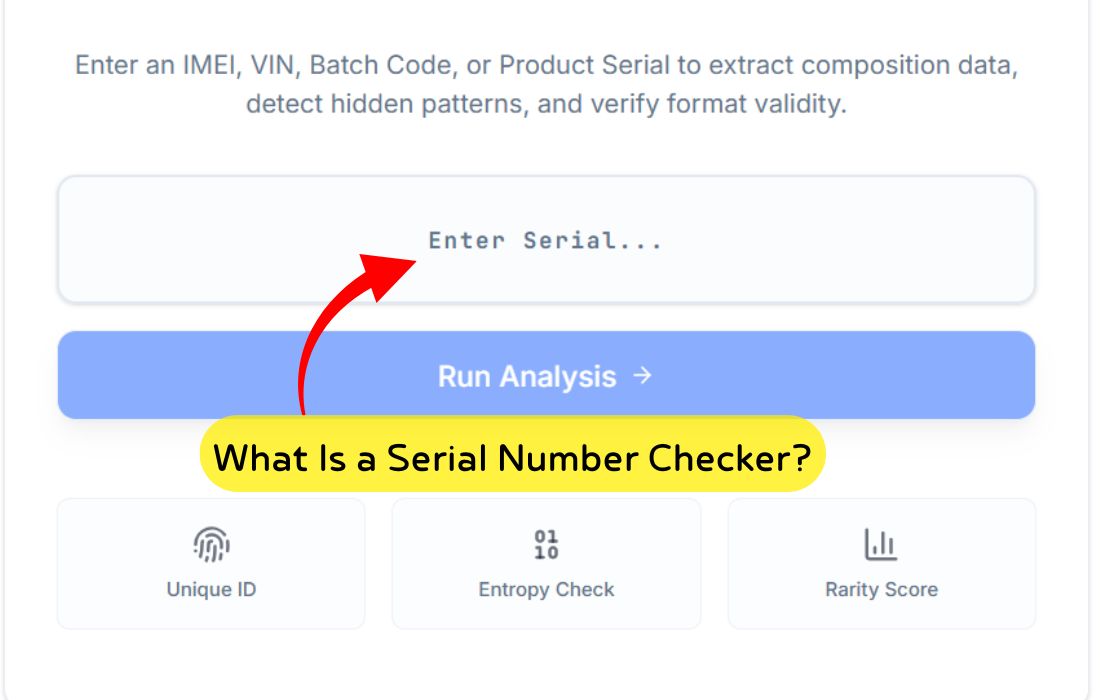
An online serial number checker is a web-based tool that validates, verifies, or analyzes serial numbers across multiple brands and product categories from a single platform.
These tools work by:
Database Cross-Referencing: Comparing your serial number against verified databases of known formats and patterns for specific manufacturers.
Format Validation: Analyzing whether the serial number structure matches the manufacturer’s documented formatting rules (character length, prefix patterns, check digits).
Multi-Brand Support: Offering verification for dozens or hundreds of brands without requiring you to visit individual manufacturer websites.
Online checkers are particularly useful when you need quick validation, are comparing multiple products, or dealing with brands that don’t offer easy manual verification options.
Pros and Cons of Online Serial Checkers
Pros
- Speed and Efficiency: Get results in seconds rather than minutes or hours. No waiting on hold or navigating complex manufacturer portals.
- Beginner-Friendly Interface: Designed for users with no technical knowledge. Simply paste the serial number and click verify.
- 24/7 Accessibility: Check serial numbers anytime, anywhere, without being restricted by business hours or time zones.
- Multi-Industry Coverage: Verify electronics, appliances, tools, vehicles, and software from a single platform.
- Batch Checking Capability: Some tools allow you to verify multiple serial numbers simultaneously, saving time for businesses or bulk buyers.
- No Account Required: Many online checkers work without registration, providing instant results.
Cons
- Accuracy Varies by Tool: Not all online checkers use verified databases. Some rely solely on format validation, which can’t confirm if a properly formatted number is genuine.
- Limited Official Status: Results may not be accepted for warranty claims or insurance purposes since they’re from third-party sources.
- Privacy Considerations: Using unknown or untrusted platforms means sharing product information with third parties.
- Database Limitations: Online tools can only verify what’s in their database. Rare products, new releases, or obscure brands may not be covered.
Related: Can Serial Numbers Be Tracked or Stolen? What You Should Know
Accuracy Comparison: Which Method Gets It Right?
Accuracy is the most critical factor when verifying serial numbers. Here’s how both methods stack up:
Manual Verification Accuracy
When you verify directly with the manufacturer, you’re accessing the definitive source of truth. If a manufacturer’s system says a serial number is valid, you can trust that information completely.
However, manual verification accuracy depends on the manufacturer’s system quality. Some brands have outdated databases that don’t reflect recent production or repairs.
Online Checker Accuracy
Reputable online serial checkers achieve high accuracy for format validation and can flag obviously fake or improperly formatted numbers instantly.
For definitive authenticity confirmation, online tools work best when they integrate manufacturer data or use verified pattern databases. Tools that only validate format cannot confirm whether a correctly formatted number actually exists in the manufacturer’s records.
When Manual Is Better
- High-value purchases requiring official documentation
- Warranty registration or claims
- Legal disputes or insurance claims
- Products from manufacturers with robust verification systems
When Online Tools Excel
- Quick preliminary checks before purchasing
- Verifying multiple products from different brands
- Checking brands without accessible manual systems
- Filtering out obvious fakes before deeper verification
The Hybrid Approach (Best Practice)
For important purchases, use online tools for fast preliminary validation, then confirm with manual verification if the purchase moves forward. This combines speed with accuracy.
Accuracy Comparison Table
Factor Manual Verification Online Checkers Source Authority Official manufacturer data Third-party databases Format Validation Confirms + validates authenticity Excellent for format checking Fake Detection Definitive Good for obvious fakes Database Coverage Single manufacturer only Multiple brands Legal Acceptance Fully accepted Generally not accepted Update Frequency Real-time Varies by platform
Speed and Convenience Comparison
Time is valuable, and verification shouldn’t become a bottleneck in your buying process.
Manual Verification Timeline
- Website lookup: 5-15 minutes (account creation, navigation, result interpretation)
- Phone support: 15-45 minutes (hold times, explanation, verification)
- Email support: 24-72 hours (response waiting period)
Online Checker Timeline
- Instant results: 5-30 seconds
- No account setup required
- No hold times or waiting periods
User Experience Differences
Manual verification requires understanding where to find serial numbers on specific products, knowing which manufacturer website to use, and navigating varying portal designs. Each brand presents a learning curve.
Online serial checkers standardize the experience. One interface works for multiple brands, reducing mental overhead and eliminating repetitive learning.
Speed & Convenience Table
Aspect Manual Verification Online Checkers Average Time 15-45 minutes Under 30 seconds Accessibility Business hours dependent 24/7 availability Learning Curve Varies by manufacturer Minimal to none Multiple Products Requires multiple sites Single platform Mobile Friendly Often poor Typically excellent Language Options Limited Usually English+
Real-World Use Cases: Which Method Works Best?
Different scenarios call for different verification approaches.
Buying Used Electronics (Laptops, Phones, Cameras)
A buyer looking at a used MacBook on a marketplace needs quick verification before meeting the seller. An online serial checker provides instant validation of format and can flag obvious red flags. If the check passes and the purchase moves forward, verifying with Apple’s official coverage checker confirms warranty status before finalizing payment.
Best approach: Online tool for screening, manual for final confirmation.
Checking Used Cars or Motorcycles
VIN verification for vehicles often requires both methods. Online VIN decoders instantly reveal make, model, year, and basic specs. Manual verification through manufacturer portals or Carfax-type services confirms accident history, recalls, and detailed specifications.
Best approach: Use both methods together.
Verifying Power Tools or Appliances
When buying a used DeWalt drill or Bosch dishwasher, you want to know if it’s authentic and what warranty coverage remains. Many tool manufacturers don’t offer public serial verification, making online checkers the only practical option for format validation.
Best approach: Online tools primarily, with manual verification if manufacturer supports it.
Software License Validation
Microsoft, Adobe, and other software companies typically require manual verification through official channels. Online checkers can validate license key format, but only manufacturer portals confirm active status.
Best approach: Manual verification required.
Authenticating Luxury Goods
For designer watches, handbags, or jewelry, manual verification through authorized dealers or manufacturer authentication services provides the documentation needed for resale or insurance.
Best approach: Manual verification exclusively.
Pre-Purchase Screening for Multiple Items
When comparing five different used laptops or phones, using an online checker lets you quickly eliminate products with suspicious or invalid serial numbers before investing time in detailed research.
Best approach: Online tools for efficiency.
Which Method Should You Choose?
Your verification needs determine the best approach:
Choose Online Serial Checkers When:
- You’re a beginner unfamiliar with verification processes
- You need results immediately
- You’re screening multiple products quickly
- The manufacturer doesn’t offer accessible verification
- You’re doing preliminary checks before purchase
- Convenience and speed are priorities
Choose Manual Verification When:
- You need official documentation
- You’re filing a warranty claim
- The purchase value exceeds $500-1000
- You require legally recognized verification
- Product authenticity is mission-critical
- The manufacturer has an excellent verification system
Use Both Methods When:
- Making high-stakes purchases
- Buying expensive used equipment
- You have time for thorough verification
- Both speed and official confirmation matter
- Contradictory information needs resolution
Where Fancy Serial Number Checker Fits
For users who need reliable, fast verification without the complexity of manual processes, Fancy Serial Number Checker offers a practical middle ground.
The platform focuses on format validation and pattern recognition across multiple product categories, helping users quickly identify obviously invalid or suspicious serial numbers. This makes it particularly valuable for preliminary screening before making purchasing decisions.
Unlike manual verification, Fancy Serial Number Checker doesn’t require creating accounts on multiple manufacturer websites or navigating varying interface designs. The tool maintains a privacy-focused approach, processing serial numbers without storing personal information or purchase details.
For users dealing with brands that don’t offer public verification systems, or when checking multiple products across different manufacturers, this type of centralized tool saves considerable time while providing a useful first-line verification layer.
It’s designed specifically for users who value convenience and want to avoid the most obvious verification pitfalls without needing to become experts in manufacturer-specific processes.
Best Practices for Serial Number Verification
Regardless of which method you choose, following these practices ensures better results:
Verify Serial Number Format First: Check that the serial number matches the manufacturer’s documented format (length, character types, positioning). This eliminates obvious errors before deeper verification.
Use Trusted Sources Only: Whether checking manually or using online tools, stick to official manufacturer websites or reputable third-party platforms with transparent methodologies.
Cross-Reference Multiple Data Points: Don’t rely solely on serial verification. Match the serial number with model numbers, manufacturing dates, and physical product characteristics.
Document Your Verification: Screenshot or save verification results, especially for high-value items. This documentation proves due diligence if issues arise later.
Verify Before Payment: Always complete verification before transferring money, especially with private sellers. A seller refusing verification time is a red flag.
Understand What’s Being Verified: Know whether a tool validates format only or confirms authenticity. Format validation alone doesn’t guarantee a genuine product.
Check for Red Flags: Mismatched information (wrong model year, discontinued product with recent serial), removed or altered serial number plates, or seller reluctance all warrant extra scrutiny.
Consider the Source: Factory refurbished products may have different serial number patterns than new items. Understand what’s normal for your specific situation.
Frequently Asked Questions
Which is more accurate, manual or online serial verification?
Manual verification through official manufacturer channels is more accurate for confirming authenticity since it accesses the definitive source. Online checkers excel at format validation and can instantly flag obviously fake numbers, but may not confirm whether a properly formatted number actually exists in manufacturer records.
Are online serial number checkers reliable?
Reliability depends on the specific tool. Reputable checkers using verified databases and manufacturer-documented patterns are reliable for format validation and screening. However, they shouldn’t replace official verification for high-stakes purchases or warranty claims.
Can I trust automated serial verification results?
Automated results are trustworthy for identifying format errors and obvious fakes. For definitive authenticity confirmation on expensive items, combine automated screening with manual manufacturer verification.
When should I use both manual and online methods?
Use both methods for purchases over $500, when buying from unfamiliar sellers, for products with known counterfeiting issues, or when preliminary online checks raise questions that need official clarification.
Do manufacturers accept online checker results for warranty claims?
Most manufacturers require verification through their official channels for warranty claims. Online checker results generally aren’t accepted as official documentation, though they’re valuable for pre-purchase screening.
How do online serial checkers protect my privacy?
Reputable checkers process serial numbers without storing personal information, purchase details, or linking data to user identities. Always review the privacy policy of any tool before use and avoid platforms requesting unnecessary personal information.
Can online tools detect stolen products?
Most online serial checkers cannot access stolen product databases. Verifying against manufacturer records or checking with local law enforcement databases requires official channels.
What should I do if manual and online results conflict?
Trust the manufacturer’s official verification when results conflict. Contact the manufacturer directly with specific details about the discrepancy. The official source always takes precedence.
Are free online serial checkers as good as paid ones?
Quality varies regardless of price. Some free tools offer excellent format validation, while some paid tools provide minimal additional value. Evaluate based on database quality, transparency about methodology, and user reviews rather than price alone.
How quickly do manufacturer verification systems update?
Update frequency varies by manufacturer. Large tech companies like Apple typically update within days of product registration. Smaller manufacturers may have lag times of weeks or months, and some never update online databases.
Can serial number formats change within the same brand?
Yes. Manufacturers often change serial number formats across product generations, production facilities, or time periods. A format that doesn’t match current patterns isn’t automatically fake if it’s from an older production run.
What information can serial numbers reveal?
Depending on the manufacturer, serial numbers may reveal manufacturing date, production facility location, model specifications, warranty period, original region of sale, and whether the product is genuine or counterfeit. The specific information available varies widely by brand.
Conclusion
Both manual serial verification and online serial number checkers serve important roles in product authentication and validation. Manual verification gives clear proof from manufacturers. It’s crucial for warranty claims, high-value purchases, and legal documentation needs.
Online serial checkers offer unmatched speed and convenience, enabling quick preliminary screening, multi-product comparisons, and validation when manufacturer systems aren’t accessible. They’re particularly valuable for beginners and situations where time matters.
The smartest approach combines both methods strategically: use online tools for initial screening and multiple product comparisons, then confirm important purchases through official manufacturer channels. This hybrid strategy delivers both efficiency and accuracy.
Understanding what each method does well—and where it falls short—empowers you to make informed verification decisions that protect your interests without wasting time.
For quick, reliable preliminary checks across multiple brands and product categories, try a trusted online serial checker like Fancy Serial Number Checker to streamline your verification process while maintaining smart buying practices.